
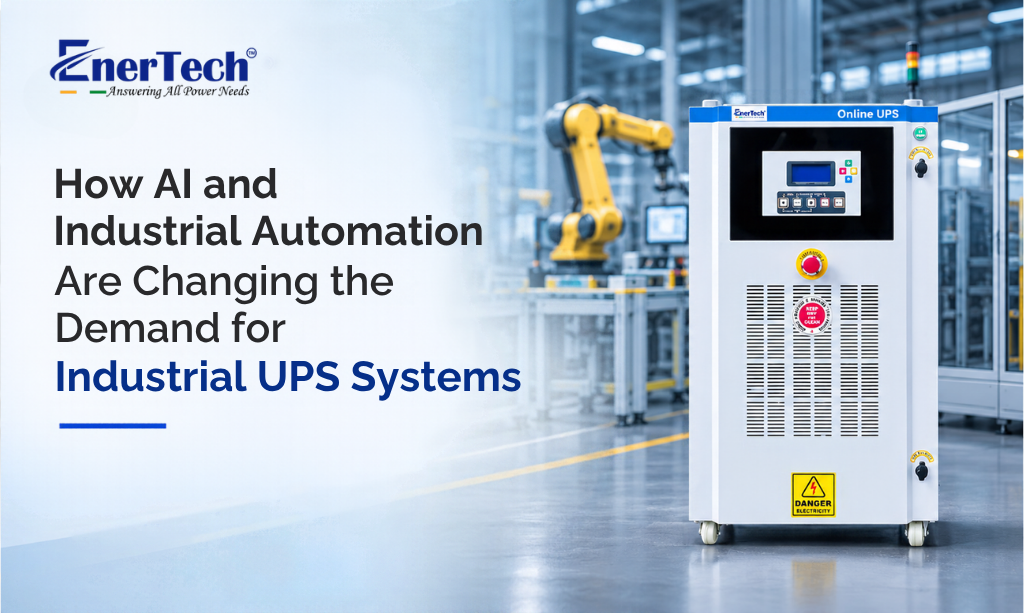
Factory shutdowns due to power interruptions can be costly.
However, when production lines rely on AI-based inspection systems, robotic equipment, connected sensors, and automated control systems, even seconds of power disturbances can lead to diverse, unimaginable losses.
Some include machine communication interruption, process control disruption, compromised operational data and loss of valuable time.
The AI wave is encouraging industries toward smart manufacturing, AI-driven production, and operational automation. But this is changing the need for reliable power infrastructure.
Industrial UPS Systems, once a backup for critical electrical loads, are becoming crucial to industrial reliability and business continuity strategies.
This shift is creating new opportunities for industrial UPS manufacturers in India and increasing the demand for advanced power protection systems. Here’s how AI and industrial automation are influencing this market.
AI-Powered Manufacturing Demands Uninterrupted Power
Although not fully, modern manufacturing significantly depends on AI for predictive maintenance, automated quality inspection, production planning, and real-time process monitoring.
The applications rely on interconnected hardware, including industrial computers, sensors, machine vision cameras, edge computing devices, and programmable logic controllers (PLCs).
Smart factories depend on continuous communication between machines and control systems. A sudden voltage fluctuation or power failure can interrupt the communication, impact production synchronization, and potentially cause an unplanned shutdown.
As a result, manufacturers are investing in Industrial UPS solutions to protect critical automation infrastructure against power interruptions. The aim isn’t just to keep every machine backed up. It is to maintain uninterrupted power to essential control, monitoring, and communication equipment.
Robotics and Automated Production Lines Require Better Power Protection
Industrial automation deploys robotic arms, autonomous mobile bots, automated material-handling systems and machine vision technologies.
These systems rely on multiple interconnected electrical and electronic components. Their controllers, industrial PCs, communication networks, and safety systems require a stable power supply to operate reliably. A power interruption during an automated operation can result in:
- Interrupted production cycles and material handling.
- Loss of communication between controllers and robotic systems.
- Unplanned equipment stoppages.
- Process interruptions requiring manual intervention.
- Additional time for system recovery and production resynchronization.
Therefore, power continuity is a vital consideration while designing automated production facilities.
Industrial power backup systems can protect selected critical loads, allowing control infrastructure to remain operational during short power interruptions or providing sufficient time for an orderly shutdown.
Edge Computing, Real-Time Data Processing and New UPS Needs
AI-powered manufacturing demands infrastructure that can collect, process, and analyze large volumes of operational data.
Here, edge computing plays a crucial role. Instead of sending every piece of information to a remote cloud platform, manufacturers can process critical data closer to the machines generating it.
Industrial edge infrastructure may include the following.
- Industrial servers and edge computing gateways.
- AI-enabled machine vision systems.
- Industrial Ethernet switches and communication equipment.
- Real-time monitoring and control devices.
- Data acquisition and processing units.
These devices often operate close to production equipment and may be installed in electrical rooms, control cabinets, or industrial enclosures.
Ensuring they operate seamlessly is crucial to ensure continuous real-time monitoring, data collection, and automated decision-making.
Online UPS systems suit such applications. The most advanced ones are equipped with double-conversion online technology that continuously converts incoming AC power to DC and then back to AC, helping isolate connected loads from many input voltage and frequency disturbances.
Predictive Maintenance Is Changing How Industries Manage UPS Systems
Manufacturers use equipment data, operating patterns, and sensor readings to identify potential failures before they cause production disruptions. The same approach is becoming relevant to power protection infrastructure.
Modern UPS systems can offer monitoring capabilities that help facility teams track important operating parameters, including battery voltage and temperature, load percentage and output conditions, input voltage and frequency, battery discharging and discharge behavior, and internal temperature and equipment alarms.
For example, a battery indicating declining performance can be inspected and replaced before it fails to provide the required backup during an outage.
Integration with building management systems (BMS), industrial monitoring platforms, or supervisory control and data acquisition (SCADA) systems can also improve visibility into power infrastructure.
Higher Automation Loads and High-Capacity Industrial UPS
A manufacturing plant that earlier needed backup for a few PLCs and control panels may now need to protect additional servers, machine vision systems, industrial networks, monitoring devices, and automated process controls.
This is creating demand for high-capacity industrial UPS installations, particularly in facilities where several critical loads need centralized power protection. But higher capacity does not mean selecting a UPS with a larger kVA rating. Industrial UPS sizing requires a detailed assessment of:
- Total connected load in kW and kVA.
- Power factor and load characteristics.
- Starting currents and transient loads.
- Required battery autonomy.
- Future capacity expansion.
- Redundancy requirements, such as N+1 configurations.
- Environmental conditions, including temperature and dust exposure.
Industrial Power Protection and Business Continuity Investment
A power interruption can affect inventory tracking, manufacturing execution systems (MES), quality records, production scheduling, and communication between different departments.
For industries operating continuous or tightly synchronized processes, recovering from an outage can involve considerable operational effort.
This is why businesses are evaluating power protection systems for industries as part of their wider operational risk management strategies.
Depending on the application, an effective solution may combine UPS equipment, generators, automatic transfer switches, power distribution infrastructure and appropriate monitoring systems.
Read: How Industrial UPS Systems Are Key for Sustainable Manufacturing
Final Words
AI and industrial automation are changing how manufacturing facilities approach power reliability. As factories become more connected, data-driven, and dependent on automated processes, even a brief power interruption can affect multiple layers of industrial operations. This makes Industrial UPS Systems essential to modern industrial infrastructure.
Manufacturers must prioritize identifying critical electrical loads, understanding their power quality requirements, and selecting scalable UPS configurations that support operational continuity.
If you are one looking to build a long-term power reliability ecosystem that goes beyond just backup, EnerTech has got you covered.
Our Industrial UPS: HTXi. It is engineered for mission-critical industrial applications where reliability cannot be compromised.
The system is also armed with True Online Double Conversion Technology that ensures uninterrupted, regulated power while protecting sensitive industrial equipment from events such as frequency variations, surges, voltage fluctuations, and complete power failures.
Want to know more? Connect with our engineers to understand how the product can cater to AI and industrial automation; email us at sales@enertechups.com.