
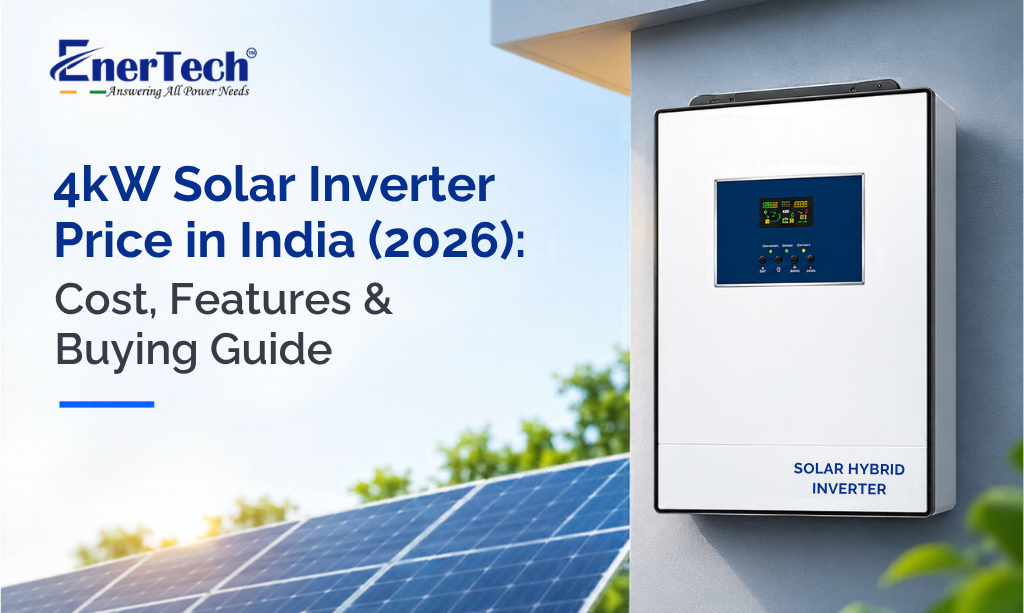
Looking to buy a 4kW solar inverter, but wondering how much it costs? A 4kW solar inverter price in India varies based on various factors. However, Nevertheless, price alone shouldn’t be the decisive factor. You must consider various other factors too. So, here’s a comprehensive buying guide.
What Is a 4kW Solar Inverter?
A 4kW inverter can output up to 4,000 watts of AC power continuously. It suits homes with a monthly consumption of about 450-650 units. That usually means a 3-4 BHK home or villa with several fans, lights, a fridge, a washing machine, and two or three air conditioners. You can usually pair it with roughly 4.4-5.2 kWp of solar panels. A slightly larger DC array is normal because panels rarely hit their rated output.
Types of 4kW Solar Inverters
- On-Grid (Grid-Tie): An on-grid inverter feeds surplus power to the grid and works with net metering. It requires no batteries. So, it is the cheapest and most efficient option. Nonetheless, it has a drawback. It shuts down during a power cut, as a safety requirement.
- Off-Grid: This inverter has batteries and works independently of the grid. Therefore, it is more suitable for areas with unreliable or no power. The battery makes this inverter costlier.
- Hybrid: This option combines solar, battery, and grid in a single unit. It can export to the grid, charge batteries, and provide backup during outages. So, while flexible, it is also the costliest.
Factors That Determine 4kW Solar Inverter Price in India
From inverter type and technology to battery compatibility, here are some essential factors that determine 4kW solar inverter cost.
- Inverter Type and Technology: On-grid units are the cheapest. Hybrid units need extra hardware for battery charging, transfer switching, and energy management. Hence, they obviously cost more.
- MPPT Efficiency: Inverters with Maximum Power Point Tracking (MPPT) extract up to 30% more energy than older models. Therefore, they are more expensive than the less efficient models.
- Phase Configuration (Single-Phase vs. Three-Phase): Single-phase 4kW inverters are standard for most Indian households and are more economical. Three-phase 4kW inverters cost 20%–35% more due to multi-phase transformerless topology and industrial-grade components.
- Build Quality and IP Rating: Inverters rated for IP65 or IP66 dust and water ingress protection can be safely installed outdoors. Outdoor-rated aluminum die-cast enclosures with passive cooling (fanless) cost more than indoor-rated models (IP21/IP30).
- Warranty and Brand Tier: Leading brands with 8-to-10-year warranties command higher upfront pricing than budget brands.
- Battery Compatibility (Hybrid Only): Support for lithium batteries and high charge currents increases the price, as does the battery itself. Ask for the battery cost separately so you can compare quotes fairly.
Read : Is A 4kW Inverter Right For Your Solar System? Here’s What You Need To Consider
Key Features to Look For
- High MPPT Efficiency and a Wide MPPT Voltage Range: This keeps output stable in low light and heat.
- Anti-Islanding and Grid-Protection Compliance: This is mandatory for net metering and prevents unsafe back-feeding during outages.
- Low Total Harmonic Distortion (THD): Under 3% is a good benchmark to protect your appliances and keep your DISCOM happy.
- Wide Operating Temperature Range: Indian summers are hard on electronics. So, ensure you also check the derating curve.
- Real-Time Monitoring: App-based tracking helps you catch faults and verify generation.
- Surge and Lightning Protection: This is a must in monsoon-heavy regions.
- Hybrid Essentials: For hybrid models, look for a fast changeover time (ideally within 10-20 milliseconds), generator input, and programmable charging.
What to Consider Before Buying
Here are the factors to consider before buying a 4kW solar inverter.
- Size the System Per Your Usage: Look at your last 12 months of bills. A 4kW system produces 14-18 units a day, depending on location and shading. Do not oversize beyond your sanctioned load or what your DISCOM allows for net metering.
- Check DISCOM and Net-Metering Rules: Each state has its rules on phase requirements, approved inverter lists, and export limits. Confirm them before you buy, as a non-compliant inverter can delay or block your connection.
- Understand the Subsidy: Under the PM Surya Ghar scheme, residential rooftop solar gets central financial assistance. For systems of 3kW and above, the support is capped at ₹78,000. Subsidy eligibility depends on using approved equipment and registered vendors.
- Decide Whether You Need Backup: An on-grid inverter is the most economical choice if power cuts are rare. If you face frequent or long outages, a hybrid inverter with batteries makes sense.
- Compare Total Cost of Ownership: A ₹10,000 saving on the inverter can disappear and disappoint you if it fails in year four. So, compare warranty, local service availability, and replacement turnaround. Most inverters need replacing once during a 25-year panel life.
- Pick a Reliable Installer: Correct wiring, earthing, ventilation, and shade-free mounting are just as important as the inverter. So, ask for a written quote that lists model, warranty, inclusions, and exclusions.
Final Thoughts
A 4kW inverter fits the needs of most medium-sized Indian homes. Therefore, for most households with a reliable grid, a good-quality on-grid inverter with a solid warranty is the smartest buy. This is where EnerTech’s 4kW/24V 1Ph HF Hybrid Inverter comes into play. Equipped with modern technologies, reliable load capacities, rapid transfer time, and diverse modes, the inverter is the right choice for millions of households and small businesses across the country. Want to know more? Email us at sales@enertechups.com.