
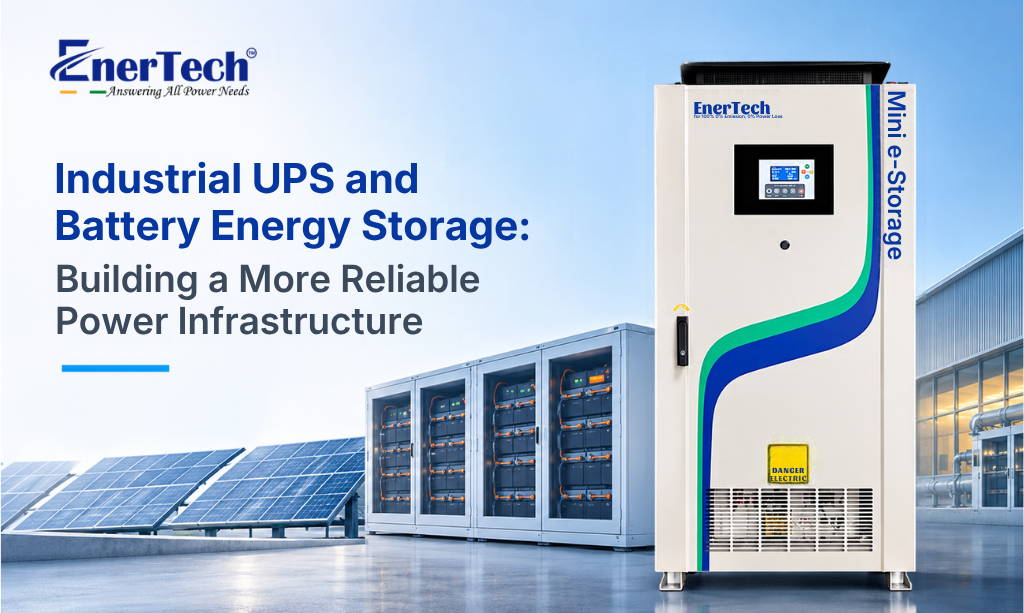
3 Phase Industrial UPS Systems and Battery Energy Storage System Solutions for Indian Industry
Indian factories run on three-phase power, and that supply is not always clean. Voltage sags, short interruptions and frequency drift disturb motors, drives and PLCs. Industrial UPS systems and a battery energy storage system solve different parts of this problem. The UPS protects sensitive loads within milliseconds. The storage system holds energy for hours and supports the wider plant. This guide explains how each works, where they fit and how to select a dependable supplier.
How Industrial UPS Systems Protect Critical Loads
Industrial UPS systems use online double-conversion technology. A rectifier converts incoming AC supply into DC. That DC charges the battery bank and feeds the inverter. The inverter then rebuilds clean AC power for the load. The load never connects directly to the utility supply. Because of this design, transfer time during a grid failure is zero.
Industrial duty is tougher than office duty. Plants run for long hours and face dust, heat and heavy inrush currents. Industrial units therefore use IGBT-based inverters, isolation transformers and rugged enclosures. The isolation transformer separates the load from the DC bus and handles unbalanced loads. Performance and safety are tested against the IEC 62040 series of UPS standards.
Why a 3 Phase Industrial UPS Suits Plant Loads
Most Indian factories receive a 415 V three-phase supply. Machine controllers, conveyor drives and process instruments need balanced voltage on every phase. A 3 phase industrial UPS delivers balanced output across all three phases. It is available as three-phase input with three-phase output, or three-phase input with single-phase output. The right configuration depends on the connected load.
Sizing starts with the load in kW and its power factor. Engineers then add margin for motor starting currents and planned expansion. Backup time decides the battery capacity. Parallel redundant configurations suit sites where a single unit failure cannot be tolerated. Online UPS ratings range from a few kVA to several hundred kVA.
Battery Technology Behind Reliable Backup
The battery bank determines how long a UPS can support the load. Valve-regulated lead-acid batteries remain common because of their lower upfront cost. They need a controlled temperature and replacement every few years. Lithium iron phosphate batteries cost more initially. They offer longer cycle life, higher energy density and built-in monitoring through a battery management system. Plants with limited floor space or frequent cycling often prefer lithium iron phosphate.
Battery Energy Storage System: Going Beyond Short Backup
A UPS covers minutes of autonomy. A battery energy storage system, or BESS, covers hours. It is a complete package, not just a battery. The main parts are battery racks, a battery management system and a bidirectional power conversion system. An energy management system controls charging and discharging. Thermal management and fire protection complete the assembly.
Industrial users apply BESS in several ways. It reduces peak demand and the related charges on the electricity bill. It stores surplus solar energy for use after sunset. It supplies critical processes during grid outages. It also supports voltage and power quality at the plant bus. Because it charges from the grid or from solar, it reduces dependence on diesel generators.
How Industrial UPS and BESS Work Together
The two systems solve different timing problems. A UPS reacts instantly and cleans the supply. A BESS delivers energy over a longer period. When the grid fails, the UPS carries sensitive loads without a break. The storage system or generator then takes over the wider plant. This layered design keeps process equipment protected and shortens generator runtime.
Both systems depend on good engineering. Battery chemistry, inverter topology and protection settings must match the site. Sizing errors lead to short backup time or wasted capital. A supplier that designs both UPS and storage can integrate them under one control philosophy.
India’s Policy Push for Energy Storage
Government support is making storage a mainstream choice. In June 2025, the Ministry of Power approved a ₹5,400 crore viability gap funding scheme. It supports 30 GWh of battery energy storage. This comes on top of 13.2 GWh already being implemented under the earlier scheme. Grid India’s resource adequacy plan for 2025–26 projected a need for 4 GW and 17 GWh of BESS. These figures show strong demand for suppliers with proven power electronics skills.
What to Check When Choosing a Battery Energy Storage System Supplier in India
Start with manufacturing capability. A supplier that designs and builds its own inverters and chargers can support the product for years. Check quality certifications such as ISO 9001:2015. Ask for test evidence on cells and packs. Relevant standards include IEC 62619 for industrial lithium cells and UL 9540A for thermal runaway. Confirm the battery management system protects against overcharge, over-discharge and overheating.
Service matters as much as the product. Look for a documented commissioning process, spares availability and round-the-clock support. Ask about warranty terms, expected cycle life and remote monitoring. A supplier with installed units across industries can share real application data. Request references from sectors similar to yours.
Frequently Asked Questions
What is an industrial UPS system?
An industrial UPS system is an uninterruptible power supply built for factory loads. It uses double-conversion technology to deliver clean power with zero transfer time. It protects motors, drives, controllers and process equipment.
How is an industrial UPS different from an office UPS?
An industrial UPS uses isolation transformers, rugged enclosures and higher overload capacity. It is designed for long running hours and harsh site conditions. Office units are built for lighter, cleaner environments.
What is a 3 phase industrial UPS used for?
A 3 phase industrial UPS protects three-phase loads such as CNC machines, process control panels and conveyor systems. It keeps voltage balanced on all phases. It also supports critical single-phase loads in the plant.
What is a battery energy storage system?
A battery energy storage system stores electrical energy in battery racks and releases it when needed. It includes a battery management system, a power conversion system and an energy management system. Industries use it for backup, peak shaving and solar storage.
How long can a BESS supply power?
Duration depends on the installed kWh and the connected load. Many commercial and industrial systems are designed for one to four hours. Larger installed capacities extend that backup time further.
Can a UPS replace a battery energy storage system?
No, because a UPS is designed for instant protection and short autonomy. A BESS is designed for longer energy supply and energy management. Many industrial plants therefore install both systems together.
Which battery is better for an industrial UPS?
Lithium iron phosphate offers longer cycle life and smaller size. Valve-regulated lead-acid batteries cost less upfront. The choice depends on budget, space, ambient temperature and cycling frequency.
How do I size a 3 phase industrial UPS?
Add up the connected load in kW and check its power factor. Include margin for motor starting currents and future expansion. Then select battery capacity based on the backup time your process needs.
What should I look for in a battery energy storage system supplier in India?
Check in-house manufacturing, ISO certification and tested battery safety. Review warranty terms, service coverage and reference installations. A supplier with UPS and storage expertise can integrate both systems smoothly.
Can a battery energy storage system work with solar?
Yes, a BESS can store surplus solar generation and release it after sunset or during peak tariff hours. A bidirectional inverter manages the energy flow between solar, battery, grid and load.
Build a Dependable Power System with EnerTech UPS Pvt. Ltd.
Reliable industrial operations need protection at every time scale. Pair a 3 phase industrial UPS with a battery energy storage system sized to your load. Contact EnerTech UPS Pvt. Ltd. for load assessment, system design and commissioning support.