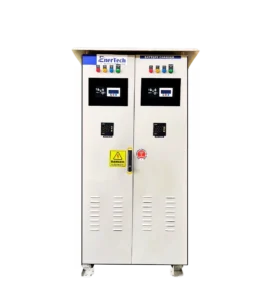
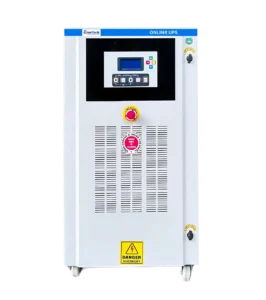
Energy Solutions can help you reduce your electricity bills
Commercial Enquiry :
+919373336340 | +919822407189
sales@enertechups.com
Customer Care & Support: +919373679255 support@enertechups.com

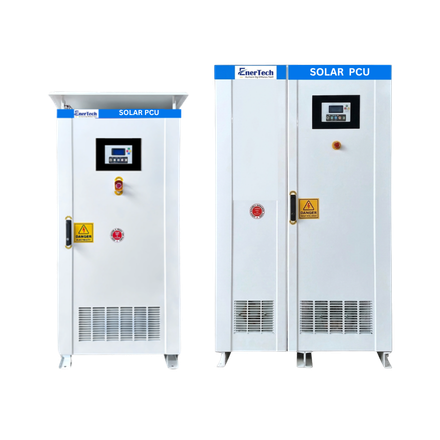

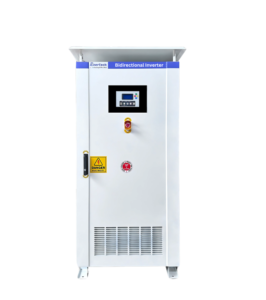
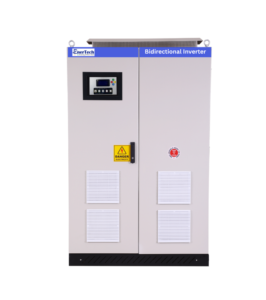
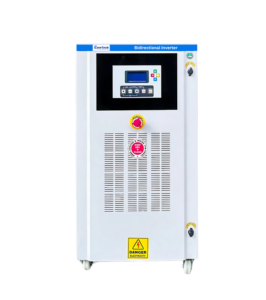
Effortlessly switch between grid-to battery modes with No Break Change over transfer times.

Store low-cost energy during off-peak hours or peak energy production, then discharge it during peak tariff windows.

Designed with flexible building blocks starting from 5 kW up to multi-megawatt systems.

Equipped with built-in CAN Bus and Modbus TCP/RTU communication protocols, the PCS communicates directly with your battery management system

Achieve up to 98% efficiency in power conversion, ensuring minimal heat generation and maximum usable power from every stored kilowatt-hour (kWh).
Provides reactive power compensation (0.8 leading to 0.8 lagging) and sub-second frequency stabilization to prevent utility penalties and power quality issues.
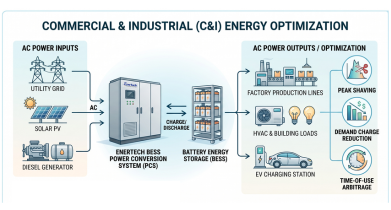

Peak Shaving & Demand Charge Reduction: Stored energy is discharged during facility peak-load events to stay below utility contract demand thresholds, avoiding steep penalties.
Time-of-Use (TOU) Tariff Arbitrage: Charges the battery bank when off-peak electricity tariffs are lowest (or free during peak solar hours) and discharges during high-tariff periods.
Motor Starting & Inrush Current Buffering: Provides instant burst power to start large inductive loads (heavy motors, compressors, CNC machinery) without causing grid voltage sags or tripping breakers.
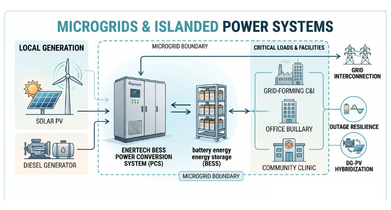

Grid-Forming Capability (Off-Grid Mode): Establishes and stabilizes local voltage and frequency references for remote manufacturing plants, mining sites, island resorts, or military bases without utility access.
Seamless Grid Synchronization (<10ms): Automatically shifts from grid-tied to islanded mode during unexpected blackouts, providing true uninterruptible power for critical processes.
DG-PV Hybridization (Diesel Optimization): Synchronizes with existing diesel generator sets to keep generators operating within their optimal fuel-efficiency band (typically 70–80% load).
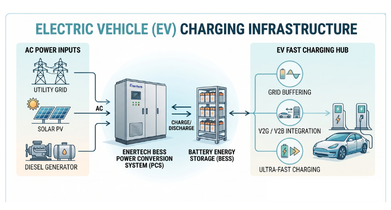

Grid Capacity Buffering for Ultra-Fast Chargers: Acts as a local energy reservoir to absorb high-power DC fast-charging spikes, eliminating the need for expensive multi-megawatt grid transformer.
Vehicle-to-Grid (V2G) & Vehicle-to-Building (V2B) Integration: Enables EV fleets and connected battery systems to discharge energy back into the facility or main grid during peak demand windows or emergency power cuts.
Renewable-Powered EV Hub Integration: Seamlessly routes onsite solar generation directly into stationary storage or charging vehicles during the day, & discharges stored green energy at night.
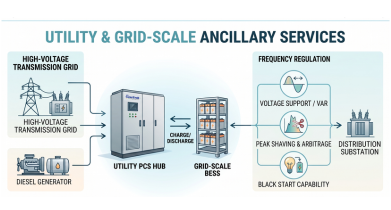

Frequency Regulation: Responds in milliseconds to grid frequency deviations (50Hz/60Hz) by rapidly charging or injecting active power.
Reactive Power (VAR) Compensation & Power Factor Correction: Provides independent active ($P$) and reactive ($Q$) power control ($0.8\text{ leading to }0.8\text{ lagging}$) to stabilize local feeder voltages without running rotating condensers.
Black Start Support: Provides the initial excitation energy needed to restart power plants and microgrid distribution segments following total grid collapse.
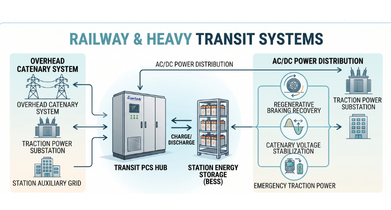
Regenerative Braking Energy Recovery: Rapidly absorbs high-power DC spikes produced during train braking and routes the captured energy directly into station auxiliary grids or battery storage banks, preventing wasted heat dissipation.
Catenary Voltage Stabilization & Peak Traction Support: Injects stored power into the traction overhead line during heavy train acceleration and steep track gradients, preventing voltage drops and stabilizing the railway power supply.
Emergency Traction & Critical Station Power Backup: Provides immediate backup power during main grid blackouts to safely move stranded trains to platforms.
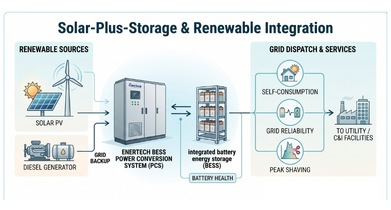
Maximizing Solar Self-Consumption: Captures excess midday solar generation that would otherwise be curtailed or exported at low feed-in tariffs, storing it for evening and nighttime operational shifts.
Renewable Intermittency Smoothing: Acts as a high-speed dynamic buffer to absorb sudden drops or spikes in solar/wind output caused by passing clouds or changing wind patterns.
Zero Export / Grid Compliance: In areas where exporting solar energy to the grid is prohibited or restricted, the bidirectional inverter redirects surplus AC power straight into battery storage.