
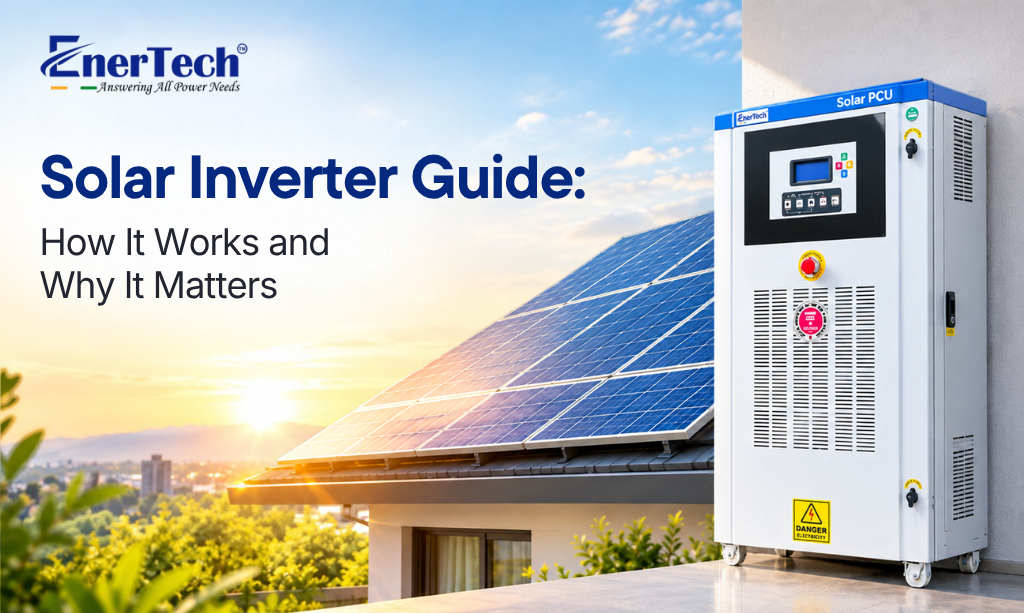
A solar inverter is the device that makes solar power usable. Solar panels produce direct current (DC), while homes, offices and factories run on alternating current (AC). The inverter converts one into the other. Without it, panel output cannot run a fan, a pump or a machine.
India crossed 100 GW of installed solar capacity in early 2025. Every one of those systems depends on an inverter. This guide explains how the technology works, which types exist and what to check before you buy.
Solar Inverter Basics: The Device Behind Every Solar System
A solar inverter is a power electronic device that sits between the solar array and the electrical load. It takes DC power from the panels and produces AC power. Indian homes run on a 230 V, 50 Hz single-phase supply. Commercial and industrial sites use a 415 V three-phase supply.
The inverter also does far more than convert power. It monitors voltage, current and temperature. It shuts the system down when it detects a fault. It also sends generation data to a mobile app or portal. For this reason, many engineers call it the brain of a solar system.
How a Solar Inverter Works from Sunlight to Socket
The process starts at the DC input. The panels send power to the inverter, and the voltage changes with sunlight and cell temperature. The inverter input must therefore accept a wide voltage range. A tracking stage then adjusts the electrical load on the array to keep the panels at their highest power output.
Next comes conversion. A switching circuit built from IGBTs or MOSFETs chops the DC into rapid pulses. Filters smooth these pulses into a clean sine wave, which forms the AC output.
A grid-tied inverter then matches its output to the grid voltage, frequency and phase. Export begins only after this match is exact. Anti-islanding protection stops the export when the grid goes down, which protects line workers during repairs. The IEC 62116 standard defines the test for this feature.
MPPT Solar Inverter Technology Explained
MPPT stands for Maximum Power Point Tracking. A solar panel produces different power at different voltages, and one voltage gives the highest power. That point shifts as sunlight and temperature change. An MPPT solar inverter tracks the point continuously and adjusts the operating voltage every few milliseconds.
Older PWM controllers do not track the power point. MPPT controllers can harvest up to 30 percent more energy than PWM controllers. The gain is highest in cold weather and low light. Models with two or more tracker inputs handle separate panel strings. This suits roofs with panels facing different directions. It also limits the loss from partial shade.
Types of Solar Inverters and Where Each Fits
On-grid inverters connect to the utility grid and need no battery. They export surplus energy and work with net metering. They shut down during a grid outage as a safety rule, so they give no backup power.
Off-grid inverters work with a battery bank and run independently of the grid. The system stores daytime energy and supplies loads at night. Hybrid inverters combine both functions. They manage solar power, battery storage and grid supply together, and they keep critical loads running during an outage.
Panel connection is a separate classification. String inverters serve a series of panels and are the most common choice for Indian rooftops. Central inverters serve utility-scale plants. Microinverters sit behind a single panel.
Why a Solar Inverter Matters for Energy Savings and Safety
The inverter decides how much panel output reaches your load. Modern units reach a peak efficiency of 97 to 98 percent. A poor unit wastes energy every day for its entire life. The inverter also provides overvoltage, short-circuit and earth-fault protection, and it isolates the system when the grid fails.
Lifespan is another key point. Solar panels carry performance warranties of 25 years, while inverters typically last 10 to 15 years. The inverter is usually the first major component to need replacement. Quality at purchase therefore decides long-term cost.
Government support also depends on the system. The PM Surya Ghar: Muft Bijli Yojana supports residential rooftop solar. The subsidy is Rs XXX per kW for the first 2 kW and Rs XXX for the third kW. The total is capped at Rs XXX, and eligibility rules apply.
How to Choose the Best Solar Inverter in India
No single model is the best solar inverter in India for every site. The right choice depends on load, roof area, grid quality and budget. Start with capacity. Match the inverter size to the panel array. A DC to AC ratio between 1.1 and 1.3 is common design practice. For off-grid or hybrid units, add up the connected loads first.
Next, compare efficiency and the MPPT range. Look for peak efficiency above 97 percent and a wide input voltage range. A wide range helps in hot weather, when panel voltage drops, and where grid voltage fluctuates.
Then check certifications and build quality. Look for BIS registration, IEC 62109-1 and IEC 62109-2 safety compliance, and IEC 62116 anti-islanding compliance on grid-tied models. Indian sites see heat above 45 degrees Celsius, dust and monsoon humidity. Choose an outdoor-rated enclosure with at least IP65 protection. Finally, read the warranty terms in writing and confirm that service support covers your city.
Solar Inverter Manufacturer and Supplier in India: What to Verify
India has many options for a solar inverter manufacturer in India. A manufacturer controls design and build quality, while a solar inverter supplier in India controls stock and delivery.
Ask where the inverter is designed and built. Ask for BIS and IEC certificates and for the number of installations in your region. Confirm how the company handles service calls and warranty claims.
People Also Ask About Solar Inverters
Is a solar inverter different from a normal inverter?
Yes. A normal inverter converts battery DC into AC and charges the battery from the grid. A solar inverter takes DC from panels and includes MPPT. Hybrid models do both jobs.
Does a solar inverter work at night?
Panels produce no power at night. An on-grid system draws from the grid after sunset. Hybrid and off-grid systems supply loads from the battery.
How many solar panels can one inverter support?
It depends on the inverter rating and the tracker limits. Total array capacity is usually 1.1 to 1.3 times the inverter rating. Check the maximum DC voltage and current per tracker.
Can a solar inverter run an air conditioner?
Yes, when its continuous and surge ratings cover the load. Air conditioner compressors draw a start-up surge well above their running current.
Which is better, MPPT or PWM?
MPPT is better for most systems because it harvests more energy. PWM controllers cost less and suit very small systems with matched panel and battery voltages.
Frequently Asked Questions
What does a solar inverter do?
A solar inverter converts DC power from solar panels into AC power. It also protects the system and reports performance data.
How does a solar inverter work?
It receives DC from the panels and tracks the maximum power point. It converts the DC to AC using fast switching circuits. Grid-tied models then match the output to grid voltage and frequency.
How does an MPPT solar inverter improve output?
An MPPT solar inverter tracks the voltage at which the panels give maximum power. It adjusts this voltage continuously. The result is a higher energy harvest than with a fixed operating point.
Which is the best solar inverter in India?
The best solar inverter in India is the one that fits your load and site. Compare efficiency, MPPT range, certifications, protection rating and warranty.
How do on-grid, off-grid and hybrid inverters differ?
On-grid inverters feed the utility grid and need no battery. Off-grid inverters run on batteries without the grid. Hybrid inverters manage solar, battery and grid supply together.
How long does a solar inverter last?
Most solar inverters last 10 to 15 years. Heat, dust and poor ventilation shorten this life.
Can a solar inverter work without a battery?
Yes. An on-grid solar inverter works without a battery. It stops operating during a grid outage. A hybrid or off-grid inverter with a battery is needed for backup power.
How do I choose a solar inverter manufacturer in India?
Check in-house design and manufacturing capability. Ask for BIS and IEC test certificates. Review installed projects and confirm service support in your city before you buy.
Does a solar inverter need maintenance?
Yes, but the effort is small. Keep the vents clear of dust, check error codes and inspect DC connectors. Book a yearly professional check and install firmware updates when released.
Talk to a Solar Inverter Supplier in India
Looking for a dependable solar inverter manufacturer in India and a trusted solar inverter supplier in India? Visit EnerTech UPS Pvt. Ltd. to explore solar inverter options and speak to the team.