
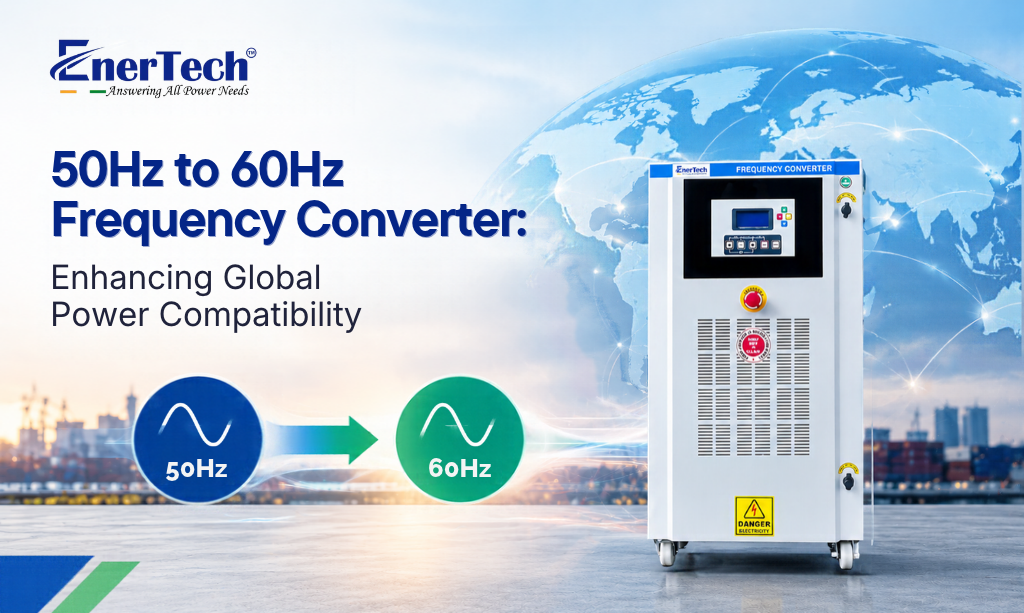
A frequency converter 50 to 60Hz changes a 50Hz power supply into a 60Hz output. It lets equipment built for one grid standard run correctly on the other. The need is common because the world does not share one frequency.
India, Europe, most of Africa and much of Asia use 50Hz grids. The United States, Canada, Saudi Arabia, South Korea, Taiwan and the Philippines use 60Hz. Japan uses both, with 50Hz in the east and 60Hz in the west. Machinery that crosses these borders often needs a frequency converter to perform as designed.
This guide explains how a 50Hz to 60Hz frequency converter works and which type to choose. It also lists what to check before buying. It is written for plant managers, procurement teams and engineers handling imported equipment.
How a 50Hz to 60Hz Frequency Converter Works
A frequency converter works in two stages. The first stage rectifies incoming AC power into DC power. The second stage uses an inverter to build a new AC waveform at 60Hz. Engineers call this process double conversion.
The output waveform is generated electronically, so it does not depend on the input grid. Output frequency stays fixed even when the input frequency drifts. Output voltage also stays regulated within a tight band. A transformer or output stage then matches the voltage to the connected equipment.
Commercial datasheets list output frequency stability near plus or minus 0.2Hz in free-running mode. Voltage regulation of about 1 percent on balanced loads is also common.
Why Frequency Matters for Industrial Equipment
Frequency controls the speed of AC motors. Synchronous speed equals 120 times the frequency divided by the number of poles. A four-pole motor turns at 1500 RPM on 50Hz and 1800 RPM on 60Hz.
A 60Hz motor on a 50Hz supply runs about 17 percent slower. Lower speed reduces fan airflow and cooling. It also cuts the output of pumps, compressors and conveyors. Windings can overheat under sustained load.
Transformers and magnetic components face a different problem. Lower frequency raises magnetic flux, which pushes the core toward saturation. Clocks, timers and control boards that count mains cycles can also drift or fault.
Types of Frequency Converters: Static and Rotary
Static converters use power electronics such as IGBTs. They have no moving parts, run quietly and need little mechanical upkeep. Efficiency in commercial datasheets typically falls between 85 and 90 percent. Static units suit laboratories, test benches and most factory floors.
Rotary converters couple a motor to a generator. The motor runs on 50Hz and drives a generator that produces 60Hz. These units tolerate heavy overloads and harsh surroundings. They are noisier, heavier and need regular bearing maintenance.
Static designs are the more common choice for new installations. Rotary sets remain in use where extreme surge capacity is required.
Key Specifications to Check Before Buying a Frequency Converter
Start with the power rating in kVA. Add up the connected load and note the highest starting current. Motors can draw five to seven times their rated current at start-up. A common practice is to size the converter 20 to 25 percent above peak load.
Confirm the input and output voltage and phase. Common input options are 230V single phase and 415V three phase. Output may need 120V, 208V, 230V or 480V, depending on the machine nameplate.
Check output waveform quality and look for low total harmonic distortion. Review overload capacity, bypass options and efficiency at partial load. Confirm protections such as over-voltage, short circuit, over-temperature and input surge protection.
Applications of a Frequency Converter 50 to 60Hz
Indian factories import packaging lines, printing presses, CNC machines and textile equipment built for 60Hz markets. A frequency converter runs these machines without rewinding motors or replacing control panels.
Laboratories, medical imaging suites and defence installations also rely on converted power. Solid-state units of several hundred kVA are built for these heavier loads.
Benefits of a Frequency Converter for Global Power Compatibility
A frequency converter lets one machine work in any country. It removes the need to modify motors, transformers or control systems. The machine stays in its original factory configuration.
Converted output is independent of grid quality. Sags, swells and frequency drift on the input do not pass to the load. This extends equipment life and reduces unplanned downtime. Relocating a machine later is simpler because the converter moves with it.
Isolation is another benefit. The double conversion design separates the load from mains disturbances such as spikes and electrical noise.
Frequency Converter vs UPS: Understanding the Difference
An online double-conversion UPS uses the same rectifier and inverter architecture as a frequency converter. The UPS adds a battery bank to ride through outages. Some international UPS models can output a different frequency from the input.
Manufacturers remain cautious about this use. APC states that using Smart-UPS Online units for frequency conversion is not officially supported or tested. Buyers should select a purpose-built frequency converter, or a UPS rated for frequency conversion by its maker.
Installation and Maintenance Practices
Install the converter in a clean, ventilated space within the manufacturer’s temperature range. Keep clear space around air vents. Use correctly sized cables and a proper earth connection. Fit upstream protection devices matched to the input rating.
Commission the unit with the actual load connected. Verify output voltage and frequency at the equipment terminals. Record the readings as a baseline for later checks.
Schedule inspections at regular intervals. Clean dust from filters and heat sinks. Check capacitors, fans and terminal tightness. Rotary units also need bearing lubrication.
Choose Enertech UPS for Your Frequency Converter Needs
Enertech UPS Pvt. Ltd. is a Pune-based manufacturer of UPS systems, solar inverters and power backup products. The company lists frequency converters among its offerings for Indian industry and export markets. Its team can match kVA rating, phase configuration and output voltage to your equipment nameplate.
Frequently Asked Questions
1. What is a frequency converter 50 to 60Hz?
It is a device that takes 50Hz AC input and delivers stable 60Hz AC output. It lets 60Hz equipment run correctly on a 50Hz grid.
2. Can a 60Hz machine run on 50Hz power without a converter?
Some machines can, but at reduced speed and with higher heating. Motors run about 17 percent slower, and transformers may saturate. Check the manufacturer’s rating before connecting.
3. Does a frequency converter also change voltage?
The conversion stage changes frequency. Most units include a transformer or output stage that also sets voltage, such as 208V or 480V. Confirm both values when ordering.
4. What is the difference between static and rotary frequency converters?
Static converters use electronics and have no moving parts. Rotary converters use a motor-generator set. Static units are quieter and lighter, while rotary units tolerate heavier overloads.
5. How do I size a frequency converter?
Add up the connected load in kVA and include motor starting current. Add a margin of 20 to 25 percent. Then select the next standard rating.
6. What is the typical efficiency of a frequency converter?
Commercial datasheets typically quote 85 to 90 percent. Actual efficiency varies with load level and design.
7. Can a UPS work as a frequency converter?
An online UPS shares the same double conversion design. However, makers such as APC do not officially support this use on standard models. Choose a purpose-built unit.
8. Which countries use 60Hz power?
The United States, Canada, Mexico, Saudi Arabia, South Korea, Taiwan and the Philippines use 60Hz. Western Japan also uses 60Hz.
9. Is a three-phase frequency converter available?
Yes. Three-phase models are widely available, with ratings from a few kVA to several hundred kVA. Input and output phase must match your equipment.
10. How often should a frequency converter be serviced?
Follow the manufacturer’s schedule. An inspection once or twice a year is common practice. Include filters, fans, capacitors and terminal connections.