
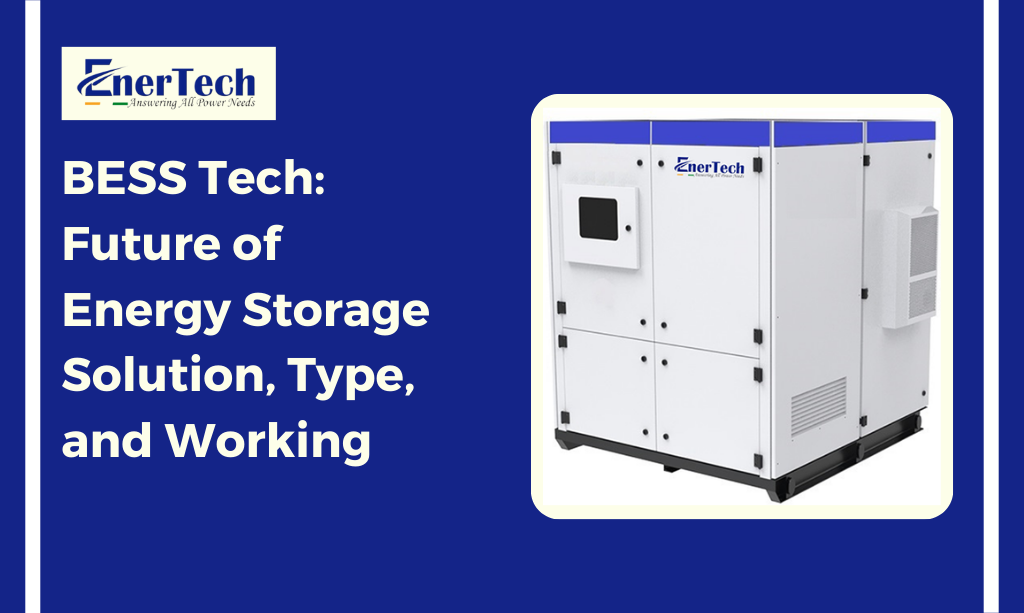
The worldwide transition toward renewable energy has accelerated the demand for large scale stationary energy storage. Intermittent generation from solar and wind installations requires flexible grid scale energy storage to maintain utility stability. Battery Energy Storage System technology has emerged as the definitive cornerstone of modern sustainable power infrastructure. We at Enertech engineer commercial, industrial, and utility scale BESS solutions to empower energy independence. Our EnerCube systems combine high density energy storage with digital energy management and bidirectional power conversion. Understanding BESS working architecture, storage chemistries, and practical applications is essential for energy planners. This technical article examines the future trajectory of BESS technology and its role in modern industrial power systems.With energy needs and costs rising and supply getting scarcer, maintaining an equilibrium between energy supply and demand is becoming a challenge. As a result, in many places, outages have become frequent and prolonged. Thus, we cannot rely on conventional sources of energy anymore, at least as much as we did earlier. Also, we cannot work with a traditional approach to energy. We can use BESS technology that can help us deal with the intensifying energy crisis.
What is the Battery Energy Storage System?
A Battery Energy Storage System is an integrated electro chemical and power electronic installation. It captures electrical energy from power grids or renewable sources and stores it in high capacity battery banks. When electrical demand peaks or the primary utility grid fails, the system instantly discharges stored power. Advanced digital controllers manage charging and discharging cycles with sub second response times. BESS systems transform volatile intermittent green power into dispatchable, base load quality electricity.The BESS full form is a Battery Energy Storage System. It helps store energy from the grid or other sources in batteries for later use. These systems store excess energy during low-demand spells or when renewable energy production is at its peak. One can use the additional energy stored during outages or when the demand is high. Thus, Battery Energy Storage System enables us to balance supply and demand. It supplies power when required, making the electrical grid more stable and reliable.Learn more about advantages of battery energy storage system.How does the BESS work?
BESS fundamentally works by storing electrical energy in batteries to enable later use. It comprises various components that contribute to its smooth and efficient operations. Let’s look at the numerous parts constituting BESS.- Battery Units: BESS has numerous battery packs or units, including lithium-ion, lead-acid, flow batteries, or other types per the application needs.
- Inverter: An inverter converts the direct current (DC) stored in the batteries into alternating current (AC) to power electrical devices or grid integration.
- Grid Connection: One can connect BESS to the electrical grid to ensure frequency regulation, peak shaving, or to store excess renewable energy.
- Storage and Release During excess energy production, BESS system stores energy in its batteries. During high demand or when renewable sources are producing energy sub-optimally, BESS releases the energy stored to meet the need.
- Monitoring and Control Systems: Monitoring and control systems are responsible for ensuring safe and efficient BESS operations by managing and monitoring the state of charge, temperature, and overall battery health.
- The Battery Subsystem comprising lithium iron phosphate battery cells configured into high voltage rack modules.
- The Battery Management System that continuously monitors cell voltage, temperature, and balancing in real time.
- The Power Conversion System which delivers bidirectional four quadrant AC to DC and DC to AC energy conversion.
- The Energy Management System executing automated dispatch algorithms for peak shaving, arbitrage, and frequency control.
Types of BESS (Battery Energy Storage System)
BESS is available in various types. Some of them include but aren’t limited to the below.- Lithium-Ion Batteries: These batteries are more efficient, have a longer cycle life, and higher energy density. So, they are used in EVs and grid-scale energy storage.
- Lead-Acid Batteries: Conventional and cost-effective, lead-acid batteries are used in UPS and smaller energy storage units.
- Flow Batteries: Flow batteries store energy in liquid electrolytes in external tanks. They are more scalable and have a lengthier cycle life.
- Lithium Iron Phosphate (LiFePO4) Batteries: lithium-ion batteries. LiFePO4 is a type of lithium-ion battery. They are more stable and durable. Hence, they are used in various applications.
Can BESS Work as a Solar Energy Storage System?
Of course, yes. BESS system represents a competent technology compatible with renewable energy storage solutions, including solar energy. You can use it to store solar energy by using it in conjunction with solar systems to store extra energy solar panels generate during the day and use it during overcast weather or night. A BESS solar energy storage system has earned fame and recognition across the energy spectrum owing to its ability to minimize the occasionally sporadic nature of solar power generation and stabilize the energy supply. Accordingly, a battery energy storage system (BESS) can help promote the use of solar energy, as it contributes to making it a more reliable electricity source.Yes BESS installations integrate directly with commercial rooftop solar and utility scale solar photovoltaic farms. Rooftop solar output naturally fluctuates due to moving clouds, causing unwanted power swings in factory circuits. A BESS smooths these fluctuations by buffering excess power and releasing it when solar irradiance dips. During nighttime hours, stored solar power runs production machinery without drawing high tariff grid electricity. This combination creates a self sustaining industrial microgrid capable of complete standalone operation.Why is BESS Technology is the Future of Energy Storage Solutions?
BESS could be termed the future of energy storage solutions for the following reasons.- Increased grid stability by providing instant energy to meet a demand surge
- Reduced peak demand on the grid by providing stored energy during peak hours
- Lowered electricity costs in the long run
- Increased energy supply continuity and enhanced backup power
- Quick release of power for improved grid balance
- Enhanced energy management by storing excess energy from various sources, including renewable ones, and using it during high demand
- Energy storage abilities prevent the need for expensive grid expansions
- Decreased dependence on non-renewable energy sources
- Continuous evolution ensures more reliability, durability, and cost-effectiveness